
Most moves go wrong in the first week, not the last one. People wait too long to ask for quotes, and by the time they do, the good dates are gone and every decision feels rushed.
A workable long distance moving timeline starts about eight weeks before moving day. In that window you collect written estimates and book a mover first, then declutter, pack in stages, and confirm every detail during the final week. If you are moving in summer or with a large household, start earlier. The sections below show what to do at each stage and why the order matters.
How Far Ahead Should You Start a Long-Distance Move?
Start planning about eight weeks out, and earlier if your move falls between May and September. A long-distance move is one where the truck travels hundreds of miles, often across state lines, and your belongings may be in transit for several days.
Timing matters because mover calendars fill up. One FreightWaves guide to peak moving season says demand runs from May through September, and it advises booking six to eight weeks ahead during those months. The same guide says peak-season prices can run 20% to 30% higher than off-season prices, and that pianos, antiques and other specialty items may need two to four months of lead time.
Here is a simple way to think about it. Off-season with a one- or two-bedroom home, six to eight weeks is comfortable. Peak season with a family home, treat eight weeks as the minimum and ten as safer.
Eight Weeks Out: Collect Estimates and Choose a Mover
Eight weeks out, your job is to gather written estimates from at least three movers and pick one. Do not spend this week packing. The mover you choose sets the dates everything else depends on.
Imagine a couple moving from Phoenix to Denver in July. If they ask for quotes in early May, they can compare three companies and still choose a pickup date that fits their lease. If they wait until mid-June, they may be choosing from whatever dates are left.
For interstate moves, federal rules help you here. The Federal Motor Carrier Safety Administration (FMCSA) says a mover must give you a written estimate of all charges, and that a casual rate quote does not count. The estimate should also come from an actual or virtual look at your belongings, not a guess over the phone.
Learn the difference between the two estimate types before you sign anything:
- Binding estimate: a guaranteed price. You pay no more than the estimate at delivery for the items and services listed.
- Non-binding estimate: the mover’s best guess. The final bill depends on actual weight and services, but the FMCSA says the mover cannot demand more than 110% of the estimate at delivery.
Also confirm the company is registered with the FMCSA, and find out whether you are dealing with a mover or a broker. A broker sells your move to another company, so you want to know who will really show up with the truck.
Weeks Seven to Five: Declutter and Decide How to Protect Your Belongings
Between weeks seven and five, sort through every room and decide what is worth moving. Long-distance moves are usually priced by the size or weight of the load, so every box you donate or sell before the move can lower the bill.
Work room by room, starting with the places you rarely use: the garage, the attic, the hall closet. A good test is whether you would pay to ship the item across the country. If the answer is no, sell it, donate it, or throw it out.
This is also the right time to understand moving liability coverage. Federal rules require interstate movers to offer two levels. Full Value Protection makes the mover responsible for the replacement value of lost or damaged goods, and it costs extra. Released Value comes at no added charge, but the mover owes no more than 60 cents per pound per article. The FMCSA gives an example: a 25-pound TV that is lost or broken would earn you $15 under that option.
If you own jewelry, antiques, or other items worth more than $100 per pound, tell the mover about them in writing. Ask for the coverage details in writing too, since the price and deductible vary from company to company.
Four Weeks Out: Start Packing and Update Your Addresses
Four weeks out, begin packing everything you will not need before moving day and start changing your address. Pack in the order you use things: off-season clothes, books, decor, and extra kitchenware first, daily items last.
Label every box with its room and a short list of contents. Number the boxes as well, so you can check them off an inventory when they arrive. If you are packing fragile items yourself, ask your mover about their packing rules and how they affect coverage.
Now is also the time to handle the paperwork that follows you across the country:
- Schedule utility shutoff at the old home and start-up at the new one.
- Transfer school, medical and veterinary records.
- Update your address with banks, insurers, employers and subscriptions.
- File a permanent change of address with the U.S. Postal Service, which generally forwards mail for 12 months at no cost.
Mail forwarding is a safety net, not a plan. Update important accounts directly so nothing sensitive keeps arriving at an empty house.
Two to Three Weeks Out: Finish Packing and Plan Your Essentials
In the two or three weeks before the move, finish packing everything except daily necessities and prepare an essentials bag for each person. Long-distance deliveries can take several days, so you need to live without your truck-bound belongings for longer than you might expect.
Your essentials bag should travel with you, not with the movers. Include medications, chargers, a few days of clothes, toiletries, important documents, and anything you would hate to lose. Keep passports, birth certificates, and financial papers with you at all times.
Use this period to sort out items most movers will not carry or will handle differently. Flammable liquids, propane tanks, and aerosol cans are common examples, but rules vary, so ask your mover for their list. Plan to use up or dispose of them safely, and drain fuel from any lawn equipment.
Defrost the freezer and clean the refrigerator a day or two ahead. Take photos of your electronics’ cable setups, and snap pictures of valuable furniture as it looks now. These photos help if you ever need to file a claim.
One Week Out: Confirm Every Detail in Writing
One week before the move, call your mover and confirm everything in writing: pickup date and window, delivery window, the estimate, the coverage you chose, and the name of a contact person. Most long-distance problems come from details that were assumed instead of written down.
Ask these questions now:
- Is my estimate binding or non-binding, and does the paperwork say so clearly?
- What is the delivery window, and who will update me if it changes?
- What forms of payment do you accept at delivery?
- Is there a parking or truck-access issue at either address?
Some local companies already build this step into their process. For example, movers offering long-distance moving services from Phoenix describe pre-move planning, written confirmation, and coordinated delivery windows as part of the job. Whoever you hire, you should expect the same level of clarity.
If you add items or services after getting the estimate, the FMCSA says you and the mover can keep the original binding estimate, negotiate a new one, or treat it as non-binding. Settle that in writing before loading starts. Once the truck is loaded without a new agreement, the original binding estimate stands.
Moving Day and the Delivery Window
On moving day, be present, walk through the home with the crew, and check the paperwork before you sign. Do a final sweep of closets, cabinets, and the garage once the truck is loaded.
Keep your copy of the bill of lading. The FMCSA advises holding on to it until your goods are delivered, the charges are paid, and any claims are settled. It is the contract between you and the mover, so treat it like an important document.
At the destination, plan to pay the driver under the terms of your estimate before unloading begins. Check each numbered box against your inventory, and note any damage on the paperwork before the crew leaves. A quick note on the day is much easier to support than a claim filed weeks later.
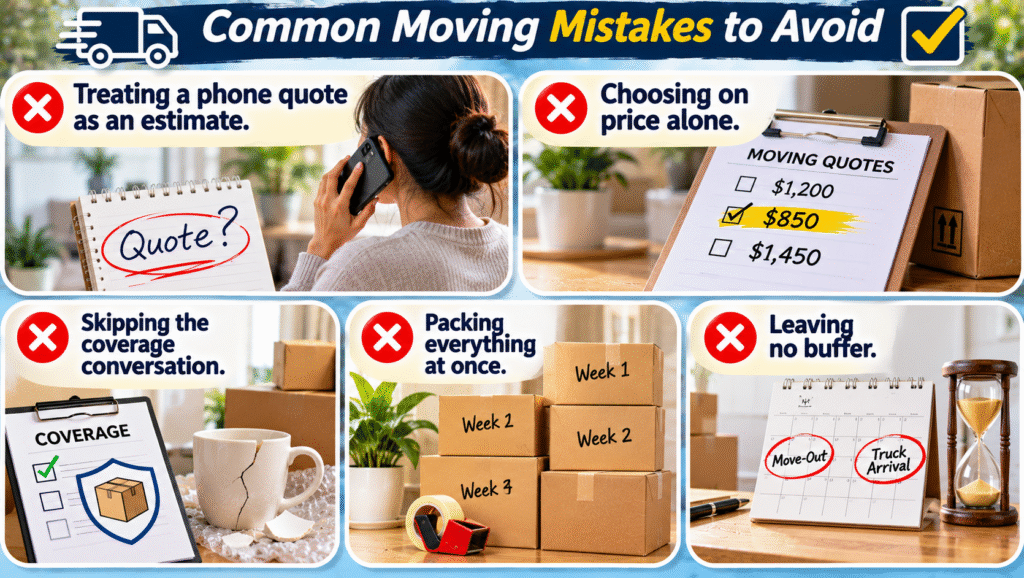
Common Timeline Mistakes to Avoid
The most common mistake is starting the search too late, but a few others cause just as much stress.
Frequently Asked Questions
How early should I start planning a long-distance move?
Start about eight weeks ahead. If you are moving between May and September, or you have a large household or specialty items, begin ten to twelve weeks ahead. Booking early gives you more date options, more time to compare estimates, and room to handle surprises.
Is a binding or non-binding estimate better for a long-distance move?
A binding estimate is usually safer because the price is guaranteed for the items and services listed. A non-binding estimate can change with the actual weight, though federal rules limit what the mover can demand at delivery to 110% of the estimate. Ask which type you are being offered.
How long does a long-distance move take?
It depends on distance, load size, and the mover’s schedule, so no single number fits every move. Cross-country moves can take several days or more in transit. Ask for a written delivery window rather than a single promised date, and plan your essentials around the longer end.
Should I pack myself or hire packers?
Packing yourself lowers the cost, but it takes time and may affect coverage on damaged items. Hiring packers saves effort and often makes claims simpler. Many people do a mix: they pack books and clothes, then leave fragile items and furniture to professionals.
What should I do in the final week before moving?
Confirm your pickup and delivery windows in writing, pack your essentials bag, and verify the estimate and coverage. Defrost appliances, set aside important documents, and double-check access at both addresses. Leave your phone charged and keep the mover’s contact number handy.
Moving Day Starts Weeks Earlier
A calm move is mostly the result of early decisions. Booking a mover, getting every figure in writing, and spreading out the packing take pressure off the last few days, when you have the least room to fix mistakes.
Pick your target moving date, count back eight weeks, and put the first step on your calendar. If you are already inside that window, start with written estimates this week, then work through the list from there.